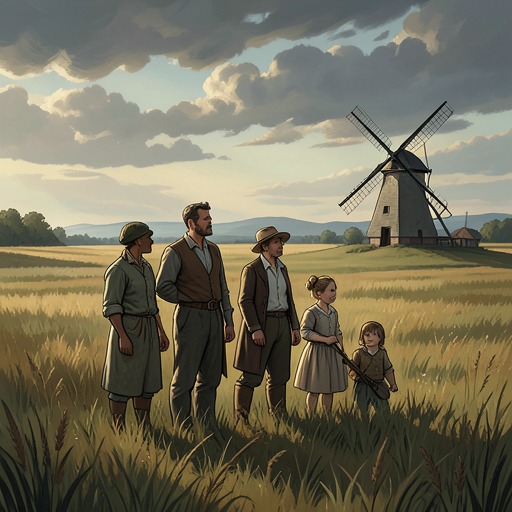
Bailey’s Explorer painting
The Sky Is EverywhereBailey’s Explorer painting is both a portrait of the family’s imagined absent mother and, after Bailey’s death, a picture Lennie Walker uses to address her sister. Its lone figure stands beyond the reach of those waving below; Lennie later places Bailey in that figure’s position, turning Bailey’s drawing into a fragile channel for grief, confession, and a hoped-for sign of forgiveness.
Origin and Composition
The painting follows a conversation about the family’s long-standing questions concerning their mother: where she went and why she left. Bailey and Lennie had imagined possible explanations, but Gram offers one they had never considered. She describes a woman traveling alone with a map and the world before her, a solo adventurer rather than someone defined by the family she left behind. Gram ends the conversation by leaving the room, her familiar way of bringing discussion to a close.
Bailey remains on the floor and draws the image. At the top of a mountain, a woman looks into the distance with her back turned to the viewer. At the mountain’s base, Gram, Big, and Lennie wave toward her; Bailey writes their names beneath their feet and places the word Explorer in green below the whole scene. The picture does not show the woman’s face, or what she sees beyond the mountain. Its central figure is defined instead by distance, solitude, and movement toward an unseen horizon.
Bailey’s omission of herself is a pointed feature of the composition. Three family members are named and gathered below, but Bailey is not among them, and the woman above is not identified by name. The drawing therefore gives the family a vivid image of a possible life for their mother without resolving the absence that prompted the conversation. It offers a story, not confirmation: the woman might be an explorer, but the picture cannot say what she has lost or what she seeks.
An Image of the Absent Mother
The painting begins as Bailey’s response to a new interpretation of their mother’s departure. Rather than imagining only abandonment, Gram’s account allows for a life organized around solitary exploration. Bailey gives that possibility visible form: the woman is high above the family, turned away from them, while their names and waving figures establish the distance between her journey and the home below.
The image does not make that distance simple or comforting. The family can be seen reaching toward the woman, but she does not turn back in the drawing. Nor does Bailey place herself with the others. The picture’s arrangement thus preserves the unanswered questions even as it introduces a less painful possibility. The word Explorer supplies a name for the woman’s imagined role, while the landscape and her turned back leave the actual story open.
Lennie’s Use of the Painting After Bailey’s Death
Later, Lennie holds the St. Anthony statue to her chest and wonders why Bailey needed it, what Bailey had lost, and what she needed to find. The painting and those questions meet around the same uncertainty: Bailey’s inner life cannot be fully recovered by looking at what she left behind. Soon afterward, Lennie puts on Bailey’s clothes, another way of drawing close to her sister through what remains present in the house.
After a period of emotional turmoil, Lennie goes to The Sanctum, which Gram has considered comparatively lucky and therefore left mostly untouched. Bailey’s belongings are still there. Lennie goes directly to the desk and begins speaking to the Explorer image, in the way she and Bailey sometimes spoke to The Half Mom. The drawing is no longer simply a record of Bailey’s answer to Gram’s story. In Lennie’s grief, it becomes an addressed surface: she speaks to the pictured figure as though her sister might hear through it.
Lennie changes the image’s meaning in a precise way. She imagines that the woman on the mountaintop must be Bailey that night. Bailey had not drawn herself into the scene, but Lennie now places her there in thought. The substitution does not alter the drawing; it alters the person Lennie sees in its central, distant figure. A picture about the family’s absent mother becomes, for a moment, a picture through which Lennie can approach the sister she has lost.
Confession and Significance
Speaking to the painting, Lennie apologizes to Bailey and says she does not understand what is wrong with her. She promises to call Toby Shaw and cancel their date in the morning. She also confesses that she did not mean what she thought in the woods and says she would do anything for Bailey to have met Joe Fontaine. Her words gather distinct sources of guilt and regret into one private appeal: what she has done, what she has thought, and the meeting Bailey will never have.
Lennie asks the pictured Bailey for a sign that she is forgiven before the list of what Lennie regards as unpardonable grows too long. The painting cannot answer, but its placement among Bailey’s belongings gives Lennie somewhere to direct a request she cannot make to her living sister. When Lennie turns toward the desk drawers, the sisters’ anti-snooping pact stops her; she has kept it, despite her habitual curiosity. That restraint makes her grief more complicated: even now, she is negotiating between wanting access to Bailey and honoring the boundaries they established together.
Unable to settle the feeling through the painting, Lennie calls Bailey’s number and hears her sister’s recorded voice before leaving a message about what happens to a companion pony when the racehorse dies. The shift from the Explorer image to the sisters’ shared racehorse metaphor shows grief moving between different forms of address: a drawing, a remembered agreement, and a phone message Bailey will not answer. The painting’s significance lies in that limited but powerful role. It does not reveal what Bailey needed or provide Lennie with the forgiveness she seeks; it lets Lennie turn an unfinished image of separation into a place where she can speak to Bailey.